
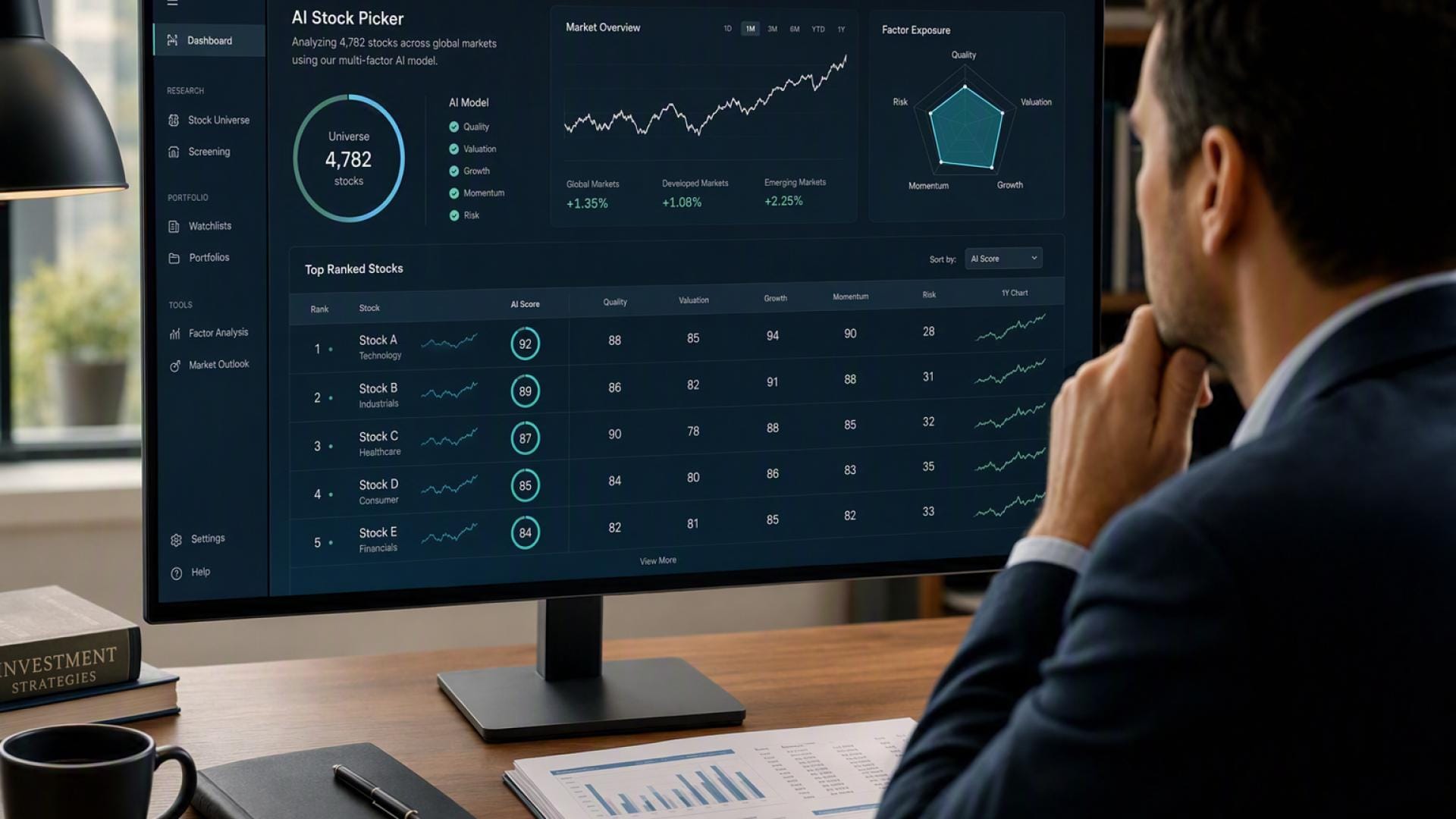
AI stock picker tools can scan thousands of companies in seconds and turn large amounts of market information into rankings, scores, or potential stock ideas. That sounds powerful. But there is an important question investors should ask before trusting any of them:
What is the AI actually measuring?
A high score doesn’t automatically mean a stock is undervalued. A bullish signal doesn’t mean the price will rise. And a model that worked well in one market environment may behave very differently in another.
The useful way to approach an AI stock picker is as a research filter—something that helps you decide which stocks deserve a closer look.
This guide focuses on that distinction and compares several tools without repeating the platforms already covered in our Best AI Investing Apps guide.
What an AI Stock Picker Actually Does
An AI stock picker doesn’t know which company will win next month. No one does, algorithm or not. What it actually does is scan large amounts of data for patterns — the kind a person could technically find by hand, but not fast enough to matter, and not without missing things along the way.
Depending on the platform, that data can include:
- Financial results (earnings, revenue growth, margins, debt levels)
- Price and volume history
- Momentum and technical indicators
- News sentiment
- Social media activity
- Insider buying and selling
- Hiring trends
- Web traffic and app usage
- Other alternative data (satellite imagery, credit card spending, shipping data, and similar sources some platforms tap into)
All of that gets compressed into something you can actually use — a score, a ranking, a forecast, or a short list of tickers worth a closer look. Say a platform flags a mid-cap industrial stock because insider buying just spiked alongside a jump in job postings for engineers. On its own, neither signal means much. Together, they might be worth a second look. That’s the real value here: instead of manually screening thousands of stocks, you start with twenty.
But it helps to be honest about what that output is and isn’t. A “92/100 buy signal” isn’t a fact — it’s a model’s best guess, built from patterns it happened to learn during training. Those patterns can and do fall apart, especially when the market does something the model has never seen before. Think of the output as a research shortcut, not a promise.
What We Looked For
Plenty of platforms slap “AI-powered” on what’s really a basic screener with a bit of extra math behind it — a weighted average dressed up as a neural network. We didn’t give credit for the label. We looked at six questions instead:
Does it explain the signal? A score with no context isn’t worth much. If a stock gets a “strong buy” rating, you should be able to see why — was it earnings momentum, insider buying, a sentiment shift, or something else? Tools that show their reasoning are more useful than ones that just hand you a number and expect trust.
What data does it use? Traditional financial data (earnings, cash flow, valuation multiples) and alternative data (social sentiment, web traffic, satellite imagery) can produce very different signals on the same stock. A platform leaning heavily on one or the other tells you a lot about what kind of investor it’s built for.
Can historical results be checked? A handful of cherry-picked success stories on a landing page means very little. What matters is whether the platform publishes a track record — ideally one that includes the losing calls too, not just the wins.
Is it built for investing or trading? A tool tuned for short-term technical signals and day-to-day price swings isn’t necessarily useful for someone building a long-term portfolio, and vice versa. The best fit depends on your actual time horizon, not the platform’s marketing copy.
Can a beginner actually use it? Complexity for its own sake isn’t a selling point. A dense dashboard full of jargon might look impressive, but if it takes a finance degree to interpret, it’s failing most of the people who’d want to use it.
What does it cost, and is that cost justified? A platform packed with advanced features isn’t good value if most users only touch two or three of them. Price should be judged against what you’ll realistically use, not the full feature list.
Best AI Stock Pickers
| Tool | Best suited for | What makes it different? |
|---|---|---|
| Prospero.ai | AI-generated stock ideas | Multi-factor signals and ranked ideas |
| AltIndex | Alternative data signals | Social, hiring, web and other non-traditional data |
| Tickeron | Active traders | Pattern recognition and trading signals |
| WallStreetZen | Stock research | Multi-factor stock ratings |
| Free AI stock-picking tools | Testing the concept | Useful for comparing signals before paying |
Important: Danelfin, Kavout, Fiscal AI, TrendSpider, Trade Ideas, Magnifi, Composer and Barebone AI are already covered on DailyTrendAI’s Best AI Investing Apps page, so we don’t need to repeat their full profiles here.
The Reality Behind AI Stock Picks
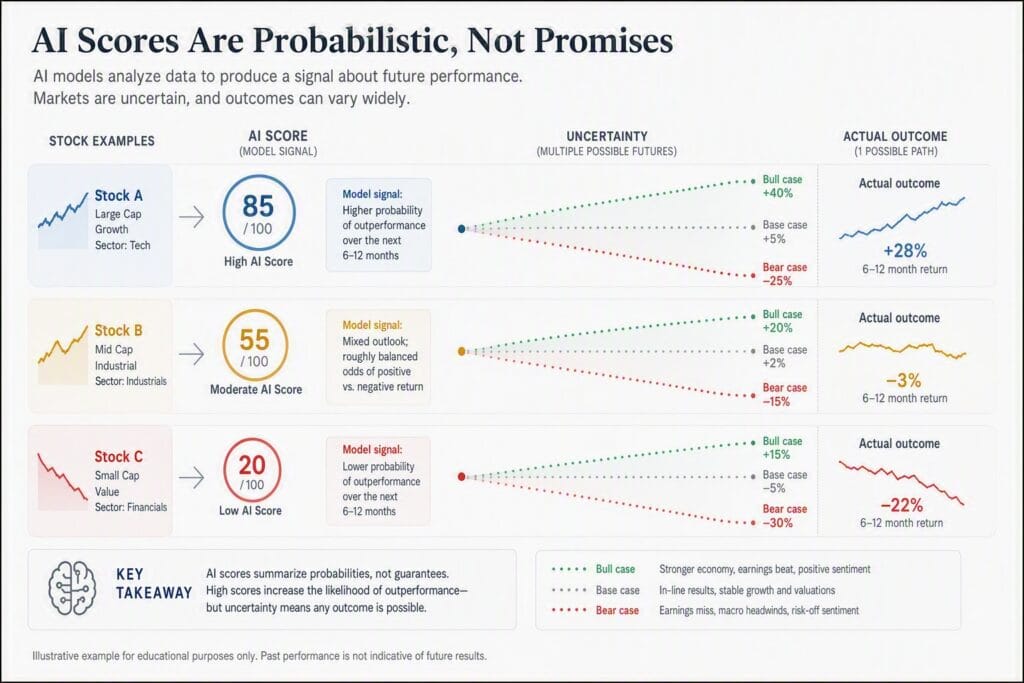
If there’s one mistake worth avoiding here, it’s confusing a prediction with a probability. They sound similar. They aren’t.
When an AI model flags a stock with several favourable signals, it isn’t saying the stock will go up. It’s saying something narrower: based on the data it has and the way it weighs that data, this stock currently looks better than the alternatives it compared it against. That’s a much smaller claim than it sounds like at first.
Here’s a simple way to see the difference. Say a model ranks three stocks like this:
| Stock | AI Score | What it means |
|---|---|---|
| Stock A | 88 | Strong combination of model signals |
| Stock B | 72 | Moderately positive signals |
| Stock C | 41 | Weaker model signals |
The instinct is to read 88 as “winner” and 41 as “avoid”. But the score only means anything inside that model’s own methodology — it’s not an external truth about the stock. Stock A can still drop tomorrow. Stock C can outperform next month. A single piece of unexpected news can undercut the assumptions behind all three scores at once. A good AI stock picker is a ranking system, not a crystal ball, and it’s worth treating it that way even when a score looks convincing.
Where AI genuinely helps. The advantage is scale, plain and simple. No person is going to track thousands of stocks, millions of data points, shifting sentiment, hiring trends, and quarterly filings at the speed software can. That’s the honest case for using one of these tools — it cuts down how much information you have to sort through by hand, not that it sees the future better than you do.
Where AI tends to fail. The flip side of scale is false confidence. A model can learn patterns that don’t hold up outside its training data, overfit to history that won’t repeat, react to noise as if it were a signal, or simply misread an event it’s never encountered before. It can also perform very differently once market conditions shift from whatever it was built on. Because of that, the useful question isn’t “does this pick winners?” It’s “does this help me make a better-informed decision than I’d make on my own?” That’s a harder bar to clear and a more honest one.
Free AI Stock Picker Options
You don’t have to pay to try one of these out. Prospero, for instance, offers a free investing app, and AltIndex lets you start on its free tier before any paid features come into play.
That’s worth taking advantage of if you’re new to this. Free access lets you run a small experiment: see what the tool recommends, do your own research on the same stocks, then watch what actually happens. Do that a few times before paying for anything.
One caution — don’t judge a tool off one or two good calls. A short winning streak tells you very little. Give it enough time and enough market conditions (a rally, a pullback, a sideways stretch) before deciding whether it’s actually earning its keep.
How to Evaluate an AI Stock Picker
Before trusting a platform with real money decisions, work through these questions:
- Can you see why a stock was picked? If not, you’re trusting a black box.
- Can you see past recommendations? A timestamped history tells you far more than a handful of highlighted wins.
- Is the performance live or backtested? Treating these as interchangeable is a common — and costly — mistake.
- What’s the intended time horizon? A three-month signal and a ten-year thesis are answering completely different questions.
- How current is the underlying data? A signal built on stale information can be actively misleading.
- What happens when it’s wrong? Every model is wrong sometimes. What matters is whether you can see that happening and manage around it.
- Are the claims realistic? Be wary of guaranteed returns, “can’t lose” language, suspiciously high win rates with no methodology shown, backtests with no explanation of how they were run, or any pressure to trade right now.
AI Stock Picker vs. AI Stock Analysis Tool
These two get lumped together, but they’re answering different questions.
A stock picker mainly answers: which stocks are worth a closer look? It narrows a huge universe down to a shortlist.
A stock analysis tool mainly answers: what do I actually know about this stock? Once you have a shortlist — ten names, say — an analysis platform helps you dig into the fundamentals behind each one: revenue, earnings, valuation, cash flow, growth trends, competitive position, and what’s actually in the filings.
Because they serve different stages of the process, we’re keeping Best AI Stock Pickers and Best AI Stock Analysis Tools as separate pieces on DailyTrendAI, with the analysis article linking back here once it’s live.
What is the best AI stock picker?
There isn’t one tool I’d call the best for everyone. It really depends on what you’re trying to do. Prospero.ai is a good choice if you want ready-made stock ideas, while AltIndex is interesting if you want to look at alternative data such as social activity, hiring trends, and web signals. If you’re more of an active trader, Tickeron makes more sense because it focuses heavily on trading signals and patterns. For broader stock research, WallStreetZen is worth considering.
Is there a free AI stock picker?
Yes, you can try several tools without paying upfront. Prospero.ai and AltIndex, for example, offer free access with some limitations. I’d recommend starting with the free version rather than subscribing immediately. Use it for a while, see what kind of stocks it identifies, and compare those ideas with your own research.
Can AI really pick stocks?
Yes—but don’t take “pick” to mean predict with certainty. An AI stock picker can analyse large amounts of data and rank stocks based on the signals its model considers important. That’s genuinely useful. But the model can still be wrong, especially when market conditions change or an unexpected event affects a company. I would use an AI pick as a starting point for research, not as an instruction to buy.
Can AI predict stock prices?
AI can produce price forecasts, probabilities, and trading signals, but I wouldn’t treat any of them as a guaranteed prediction. Markets simply don’t work that way. Even a good model can be caught off guard by earnings surprises, economic news, interest-rate changes, or sudden shifts in investor sentiment. A forecast is useful when you understand what it is based on—not when you treat it as a certainty.
Should beginners use an AI stock picker?
Yes, but I would keep it simple. For a beginner, Prospero.ai can be useful for finding stock ideas, while WallStreetZen can help you look beyond a simple buy or sell signal and examine the stock more closely. The important thing is not to blindly follow the recommendation. Ask why the tool selected the stock, check the company’s fundamentals, and decide whether it actually fits your investment goals.
What is the difference between an AI stock picker and an AI stock analysis tool?
Think of it this way: an AI stock picker helps you find stocks, while an AI stock analysis tool helps you understand them.
A stock picker might give you a shortlist of companies that its model considers interesting. Once you have that shortlist, an analysis tool can help you look at things like revenue, earnings, valuation, cash flow, and growth.
So they work well together rather than competing with each other.
Are AI stock-picking signals reliable?
They can be useful, but I wouldn’t judge a tool simply by looking at its best-performing picks. Check how the recommendations were generated, whether the platform shows a meaningful historical record, and whether the results are based on backtesting or actual live performance.
Most importantly, remember that every model has periods when it gets things wrong. A useful AI stock picker isn’t one that never makes mistakes; it’s one where you can understand the methodology and use the signals as part of a sensible research process.
Conclusion
The most useful AI stock picker isn’t necessarily the one that promises the highest returns.
It’s the one that helps you find better questions to investigate.
Prospero can help narrow the stock universe into actionable ideas. AltIndex brings alternative data into the process. Tickeron is more useful for active technical trading, while WallStreetZen takes a broader research approach. But the real advantage of AI isn’t that it can see the future. It’s that it can process information at a scale a person cannot.
Use that advantage. Let AI find patterns and candidates. Then look underneath the score, check the underlying data, understand the business, and decide whether the opportunity actually makes sense for you.
AI should shorten your research process—not replace your judgement.
For the broader picture, see our AI Investing guide and Best AI Investing Apps comparison.
By DTAI Team
This article is for educational purposes only and is not financial advice. Investing involves risk, including loss of principal. Features and pricing of third-party platforms can change.