
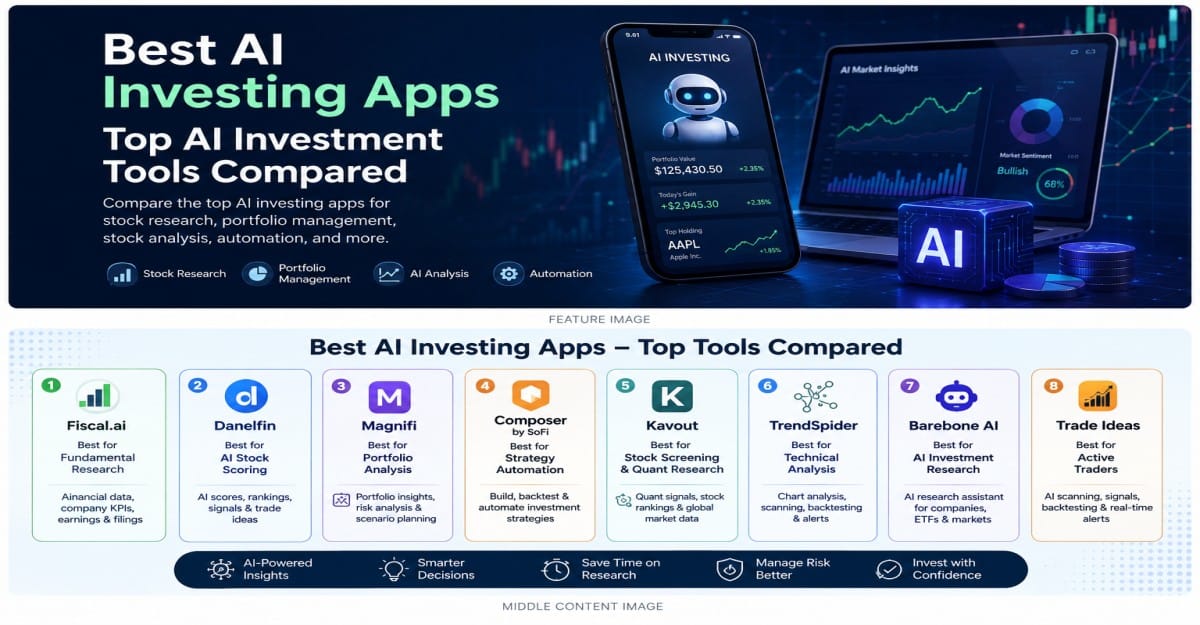
Best AI investing apps can help investors research companies, analyze portfolios, screen stocks, test strategies, and make sense of large amounts of financial data. But the tools available today are very different from one another.
Some are built for fundamental research. Others focus on stock scores, technical analysis, portfolio management, or automated strategies. A platform that works well for an active trader may be far too complicated for someone building a long-term portfolio.
This guide compares several leading AI investing apps and tools based on what they actually do, who they are designed for, their main strengths, and the type of investor who may benefit from them. If you are new to the subject, start with our broader guide to AI investing and our AI in Finance pillar.
Quick answer: There is no single best AI investing app for everyone. The right choice depends on whether you need fundamental research, stock analysis, portfolio management, strategy automation, or active-trading tools.
Best AI Investing Apps at a Glance
| Platform | Best for | Main strength |
|---|---|---|
| Fiscal.ai | Fundamental research | Financial statements, company KPIs, and investment research |
| Danelfin | AI stock scoring | AI-based stock and ETF scores |
| Magnifi | Portfolio insights | Portfolio analysis, risk, and scenario tools |
| Composer by SoFi | Strategy automation | Building and automating systematic strategies |
| Kavout | Stock screening | Quantitative and AI-assisted stock research |
| TrendSpider | Technical analysis | Automated technical analysis and backtesting |
| Barebone AI | Investment research | AI-assisted company and market research |
| Trade Ideas | Active trading | AI-powered market scanning and trading signals |
Note: Features, pricing, availability, and integrations can change. Check the provider’s official website before subscribing or connecting a brokerage account.
How We Evaluated These AI Investing Apps
Calling a product an “AI investing app” does not automatically make it useful. For this comparison, the more important question is what the AI actually helps an investor do.
We considered:
AI capabilities: Does the platform use AI or machine learning for a meaningful investment task—research, screening, scoring, forecasting, portfolio analysis, or strategy development? Some tools use AI as a core feature; others bolt it on as a minor add-on, so it’s worth checking how central it actually is to what you’d use the platform for.
Stock analysis: Can investors examine company fundamentals, technical indicators, sentiment, valuation, or other market information? Look at whether the platform gives you raw data to interpret yourself or packages it into a finished score or recommendation—the two suit different types of investors.
Portfolio management: Does the platform help investors understand holdings, diversification, risk exposure, or potential portfolio changes? This matters more once you’re managing a full portfolio rather than researching individual picks, since it shifts the focus from “what to buy” to “how everything fits together.”
Can automation automate alerts, rebalancing, strategy execution, or other investing tasks? More automation means less day-to-day effort, but it also means checking how much control you keep over trades and whether you can step in when something looks off.
Can investors test an investment strategy against historical market data? This is especially useful for anyone building or refining a systematic strategy, though past performance in a backtest still doesn’t guarantee future results.
Transparency: Does the platform provide enough information for users to understand how its analysis or scores are generated? A tool that explains its reasoning makes it easier to catch mistakes and decide how much weight to give its output.
Ease of use: Is the product appropriate for beginners, experienced investors, or active traders? A platform built for quantitative traders can feel overwhelming to a beginner, while a beginner-friendly tool may feel too basic for someone running more advanced strategies.
Cost: Does it offer a free plan, trial, or reasonable entry point? Worth weighing against what you’d actually use—a powerful but expensive tool isn’t worth much if it covers features you’ll never touch.
The goal is not to declare one universal winner. It is to help you identify the tool that best matches your investing needs.
1. Fiscal.ai
Best for: Fundamental investment research Fiscal.ai is designed for investors who want to spend more time understanding companies and less time collecting financial information from multiple sources. It focuses heavily on financial statements, company KPIs, filings, earnings information, estimates, and investment research—making it a strong fit for investors who prefer fundamental analysis over technical signals. It also offers AI-assisted research tools to help organize and interpret company information. Best suited to: Investors who want to research a company’s financial health before making an investment decision.
Key features: Financial statement research · Company KPIs · Earnings and filing information · Equity research · Financial data analysis · Portfolio statistics · AI-assisted research
| Pros | Cons |
|---|---|
| Strong fundamental-research focus | More research-oriented than beginner-focused |
| Useful financial data | Not primarily designed for automated trading |
| Suitable for deeper company research | |
| Free option available |
2. Danelfin
Best for: AI stock scoring Danelfin takes a different approach to AI-powered investing. Instead of trying to be an all-purpose portfolio platform, its main feature is an AI score that ranks stocks and ETFs using a combination of technical, fundamental, and sentiment-related signals. This can be useful when an investor has a large list of stocks and wants a systematic way to narrow it down for further research. The scoring system shouldn’t be interpreted as a guarantee that a stock will rise—it’s better viewed as an additional research signal. Best suited to: Investors who want AI-assisted stock screening and ranking.
Key features: AI stock scores · Stock and ETF rankings · Fundamental signals · Technical signals · Sentiment indicators · Portfolio analysis · Trade ideas
| Pros | Cons |
|---|---|
| Simple scoring approach | Scores shouldn’t replace independent research. |
| Free plan available | More focused on stock selection than complete financial planning |
| Useful for screening stocks | |
| Combines different market signals |
3. Magnifi
Best for: Portfolio analysis Magnifi focuses more on the investor’s existing portfolio than on finding individual stocks. It can help investors examine holdings, performance, risk, exposure, investment opportunities, and potential scenarios—making it particularly useful for someone who already owns investments and wants a clearer picture of how they fit together. It also offers tools to explore hypothetical portfolio outcomes rather than just looking backward at past performance. Best suited to: Investors who want AI-assisted insights into their existing portfolio.
Key features: Portfolio analysis · Risk and exposure analysis · Investment discovery · Goal-based planning · Scenario analysis · Portfolio forecasting · Personalized investment insights
| Pros | Cons |
|---|---|
| Strong portfolio focus | Less focused on deep company research than Fiscal.ai |
| Useful for existing investors | Some advanced capabilities require a paid plan. |
| Scenario analysis can help with planning. | |
| Free option available |
4. Composer by SoFi
Best for: Building and automating investment strategies Composer is different from most research-focused AI investing tools. It’s designed around creating systematic investment strategies, testing them, and automating them. In 2026, Composer became Composer by SoFi following SoFi’s acquisition of Composer Securities. The platform is particularly interesting for investors who have a specific strategy in mind but don’t want to build the entire system from scratch. Best suited to: Investors who want to create and automate systematic investment strategies.
Key features: Strategy creation · Natural-language strategy development · Backtesting · Portfolio automation · Rule-based investing · Strategy execution
| Pros | Cons |
|---|---|
| No-code approach | Better suited to investors who already understand investment strategies |
| Useful for systematic investors | Automation can magnify mistakes. |
| Combines strategy development and automation | Primarily focused on the U.S. market |
5. Kavout
Best for: AI stock screening and quantitative research Kavout focuses on quantitative investment research and AI-assisted stock selection. Its tools include stock rankings, AI research agents, financial metrics, technical signals, and portfolio analysis—particularly useful for investors who want to screen large numbers of securities rather than manually investigate every company. Its quantitative approach can make it more suitable for experienced investors than someone completely new to investing. Best suited to: Investors looking for quantitative and AI-assisted stock screening.
Key features: AI stock screening · Stock rankings · AI research agents · Fundamental analysis · Technical indicators · Quantitative signals · Portfolio tools · Global market coverage
| Pros | Cons |
|---|---|
| Strong quantitative focus | Can feel complicated for beginners |
| Broad research capabilities | More focused on research and screening than complete financial planning |
| Useful for systematic screening | |
| Supports multiple markets |
6. TrendSpider
Best for: Technical analysis TrendSpider is aimed more at active investors and traders than traditional long-term portfolio investors. It combines automated technical analysis, market scanning, backtesting, alerts, strategy tools, and AI-assisted research. If your investing process relies heavily on charts and technical indicators, TrendSpider offers a much deeper toolkit than a typical portfolio app. Best suited to: Active investors and traders who rely on technical analysis.
Key features: Automated technical analysis · Market scanning · Backtesting · Alerts · Strategy testing · AI-assisted analysis · Trading automation
| Pros | Cons |
|---|---|
| Powerful technical analysis tools | More complex than beginner-oriented tools |
| Strong scanning capabilities | Can be expensive for casual users |
| Backtesting support | Better suited to active traders than simple long-term investing |
| Useful for active strategies |
7. Barebone AI
Best for: AI-powered investment research Barebone AI is positioned as an AI investment research platform rather than a conventional brokerage application. Its tools help investors conduct company research, examine financial information, analyze portfolios, research ETFs, and explore investment scenarios. One of its more useful traits is a focus on financial research rather than treating AI as a general-purpose chatbot. Best suited to: Investors who want an AI research assistant focused on financial analysis.
Key features: AI investment research · Company analysis · Portfolio monitoring · Financial data analysis · Earnings research · ETF research · Scenario analysis · AI-assisted workflows
| Pros | Cons |
|---|---|
| Broad investment-research focus | More research-oriented than execution-oriented |
| Designed specifically around financial analysis | Some capabilities may require a paid plan. |
| Useful for conversational research | |
| Covers multiple research workflows |
8. Trade Ideas
Best for: Active and day traders Trade Ideas is designed for a very different type of investor. Its Holly AI system is focused on identifying and evaluating trading opportunities for active market participants, alongside scanning, alerts, strategy testing, and simulated trading tools. This makes it far more relevant to active traders than someone building a retirement portfolio. Best suited to: Experienced active traders looking for AI-assisted market scanning.
Key features: Holly AI · Real-time market scanning · Trading signals · Backtesting · Simulated trading · Alerts · Strategy analysis
| Pros | Cons |
|---|---|
| Strong active-trading toolkit | Higher cost than many beginner tools |
| AI-assisted market scanning | Steeper learning curve |
| Strategy testing | Not primarily designed for long-term portfolio investing |
| Designed for experienced traders |
How AI Investing Tools Work
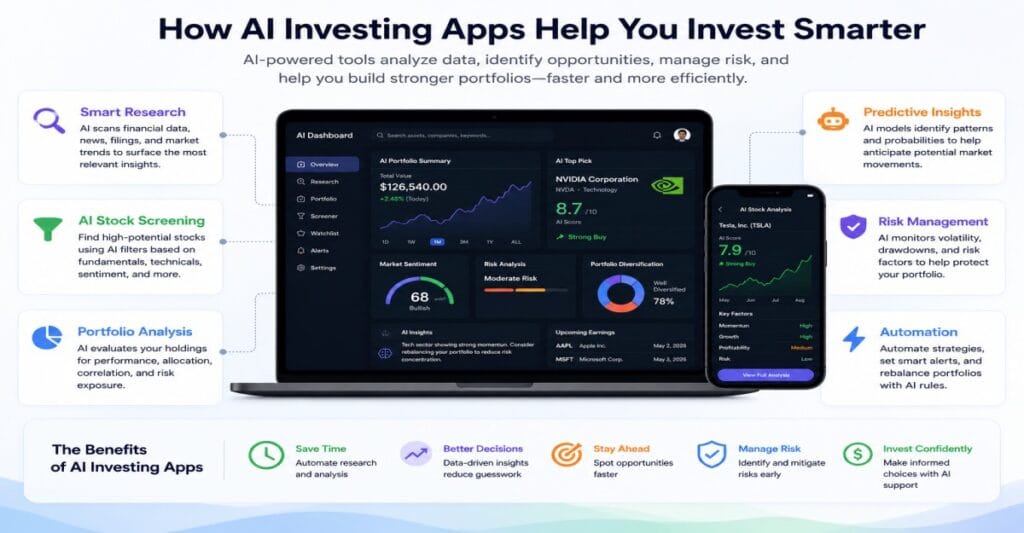
AI investing tools can use several technologies at once, including machine learning, natural-language processing, statistical models, financial databases, technical indicators, and alternative data.
A typical workflow might look like this:
- The platform collects financial data.
- AI models process and organize the information.
- The system identifies patterns or relationships.
- Stocks or portfolios are scored or analyzed.
- The results are presented to the investor.
- Some platforms allow the investor to test or automate a strategy.
For example, a stock-analysis platform may evaluate thousands of indicators and generate a ranking. A portfolio platform might analyze diversification and risk exposure. A strategy platform may test an investment rule against historical market data.
The important distinction is that AI can analyze probabilities and patterns, but it cannot know the future with certainty.
Can AI Help With Investing?
Yes. AI can help with investing, but it works best as a research and decision-support tool.
Depending on the platform, AI can help investors:
- Screen stocks
- Analyze financial data
- Summarize company information
- Compare investments
- Monitor portfolio exposure
- Identify patterns
- Test strategies
- Track risk
- Organize research
What AI cannot do is eliminate uncertainty.
An investor still needs to consider valuation, diversification, risk tolerance, investment horizon, taxes, liquidity needs, and the possibility that an AI-generated conclusion is wrong.
Are AI Investing Apps Safe?
AI investing apps can be useful, but they are not automatically safe.
There are several risks investors should understand.
Model risk
A machine-learning model may perform well on historical data but behave differently when market conditions change. A successful backtest does not guarantee future performance.
Data risk
AI systems depend on their inputs. Incorrect, outdated, incomplete, or misleading financial data can result in poor analysis. The SEC warns investors that AI-generated information can be inaccurate, incomplete, misleading, or even fabricated. SEC Investor Alert: Artificial Intelligence and Investment Fraud
Black-box risk
Some AI systems do not clearly explain how they generate a score or recommendation. If you cannot understand the reasoning behind a recommendation, you should treat it as one input rather than a decision.
Automation risk
Automation can make investing more convenient, but it can also magnify mistakes. An incorrectly configured strategy could potentially generate repeated trades or unwanted portfolio changes.
Fraud risk
AI can also make investment scams more convincing. Fake platforms, impersonation, fabricated performance claims, and unrealistic promises can all appear more credible when AI-generated content is involved.
For U.S. investors, the SEC’s EDGAR database can be used to review company filings and verify important corporate information. SEC EDGAR
Never assume that a platform is legitimate simply because it claims to use artificial intelligence.
Best AI Investing Apps for Beginners
If you’re new to AI investing, the platform with the most features isn’t necessarily the best choice. A tool packed with advanced screeners, custom strategy builders, and dense data dashboards can be more overwhelming than helpful when you’re still getting your footing.
A beginner should generally look for:
- Simple navigation—you shouldn’t need a tutorial just to find your portfolio.
- Clear explanations—plain language over jargon-heavy analysis.
- Transparent pricing—no hidden fees or unclear upgrade paths.
- Reliable financial data—accurate, up-to-date information you can trust.
- Educational resources—guides or explainers that help you learn as you go, not just raw output.
- Understandable recommendations—you should be able to see why a suggestion was made, not just the suggestion itself.
- Limited automation—enough hands-on control that you’re learning the process, not just clicking “accept.”
Magnifi is a reasonable option for investors who already have a portfolio and want help understanding their holdings and risk. It’s less about discovering new ideas and more about making sense of what you already own.
Danelfin is useful for investors who want a straightforward way to screen and compare stocks using AI-generated scores. The scoring format gives beginners a simple starting point without requiring deep technical analysis skills.
Barebone AI is worth considering for investors who prefer asking questions and conducting research conversationally. This can feel more approachable than navigating menus and filters, especially for someone still learning what to even ask.
The most important rule for beginners is simple: understand what the tool is doing before relying on it. No platform, however well-designed, replaces the value of knowing why a recommendation was made.
What is the best AI investing app?
There is no single best AI investing app for everyone. Fiscal.ai is particularly useful for fundamental research, Danelfin for AI stock scoring, Magnifi for portfolio analysis, Composer by SoFi for strategy automation, and TrendSpider for technical analysis.
What is the best AI investment app for beginners?
Beginners should generally prioritize simplicity, transparency, and education over advanced automation. Magnifi, Danelfin, and research-focused platforms such as Barebone AI may be worth considering depending on the investor’s goals.
Can AI help with investing?
Yes. AI can help with stock screening, financial research, portfolio analysis, risk monitoring, strategy testing, and other investing tasks. However, it cannot eliminate investment risk or guarantee returns.
Are AI investing apps worth it?
They can be worthwhile when they save significant research time or provide analytical capabilities that would otherwise be difficult to access. The value depends on the investor’s needs, the platform’s capabilities, and its cost.
Can AI predict stock prices?
AI can generate forecasts and probabilities using historical and current information, but no AI system can reliably predict future stock prices with certainty.
Are AI investing apps safe?
They can be used responsibly, but investors should research the provider, understand the platform’s data and automation features, verify important information, and be cautious of guaranteed-return claims.
Conclusion
The best AI investing apps are not necessarily the ones that make the biggest claims about artificial intelligence. A better approach is to choose a platform based on the specific problem you want it to solve.
Fiscal.ai is a strong option for fundamental company research. Danelfin focuses on AI-powered stock scoring. Magnifi is built around portfolio analysis and personalized insights. Composer by SoFi focuses on systematic strategy creation and automation. Kavout provides quantitative stock-screening capabilities, while TrendSpider is better suited to technical analysis and active trading. Barebone AI focuses on AI-assisted investment research, and Trade Ideas is aimed at experienced active traders.
AI can make investment research faster and help investors work with large amounts of information. But it should remain a tool in the decision-making process, not the decision-maker itself.
Editorial note: Product features, pricing, availability, and integrations can change. Check the provider’s official website before subscribing or connecting an investment account. This article is for educational purposes and is not financial advice.
1 thought on “Best AI Investing Apps: Top AI Investment Tools”