

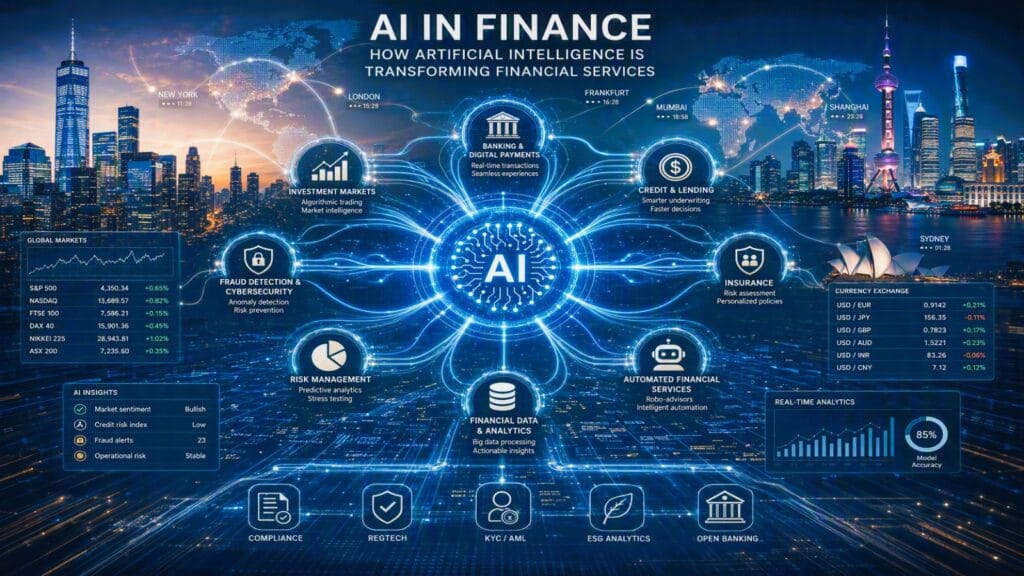
Artificial intelligence is becoming part of the infrastructure behind modern financial services. AI in finance is already being used to detect fraud, assess credit risk, analyse markets, automate operations, improve customer service, support investment research, and monitor financial activity.
For consumers, much of this technology works in the background. A bank may use AI to identify an unusual card transaction, while an investment platform may automatically rebalance a portfolio. An insurance company may use machine learning to process claims, and a lender may use automated models to assess credit risk.
The transformation is happening across major financial markets, including the United States, Canada, the United Kingdom, the European Union, Australia, India, China, and other parts of Asia. However, adoption and regulation are not identical everywhere.
This guide explains what AI in finance means, where it is being used, the technologies behind it, its benefits and risks, regional differences, real-world examples, and what the next generation of financial AI could look like.
What Is AI in Finance?
AI in finance refers to the use of artificial intelligence to analyse financial information, recognise patterns, make predictions, automate workflows, support decisions, and interact with customers or employees. It includes much more than chatbots. A fraud-detection model, an AI-powered credit assessment system, an automated investment platform, a document-analysis system, and an intelligent customer-service assistant can all be considered financial AI.
Several technologies work together to make these systems possible.
Machine learning identifies patterns in historical and real-time data. Natural language processing helps computers understand financial documents and human language, while generative AI can summarise information, create reports, answer questions, and assist employees.
Newer AI agents can potentially perform multiple connected tasks instead of simply answering a single question. For example, an agent could retrieve a financial document, extract information, compare it with internal records, identify an exception, prepare a report, and send the case to a human reviewer.
That evolution is important because the future of financial AI is moving from individual tools toward AI-assisted financial workflows.
Why Finance Is a Natural Industry for AI
Finance generates enormous amounts of structured and unstructured data.
Banks process transactions and customer records. Investment firms analyse market prices, company filings and economic information. Insurers process claims and risk information. Regulators examine financial activity across entire markets.
Humans cannot manually analyse all of this information continuously.
AI can process large datasets quickly and identify patterns that might otherwise take analysts hours, days, or weeks to discover.
For example, an AI system monitoring millions of transactions does not need to examine every transaction manually. Instead, it can identify unusual combinations of behaviour and send higher-risk cases to investigators.
This does not make AI infallible. It simply changes the scale and speed at which financial information can be analysed. The Financial Stability Board has emphasised that financial institutions are increasingly using AI to improve operations and services, while also warning that rapid adoption can introduce new risks that require organisation-wide governance and controls.
Major Applications of AI in Finance
1. AI for Fraud Detection
Fraud detection is one of the most established uses of AI in financial services. Traditional systems often depend on predefined rules. For example, a bank might flag an unusually large transaction or a purchase made from an unexpected location.
AI can analyse a much wider behavioural picture.
It can examine:
- Transaction amounts
- Locations
- Devices
- Spending patterns
- Login behaviour
- Transaction frequency
- Account relationships
- Merchant activity
Example: Detecting suspicious account activity
Imagine a customer normally makes small domestic purchases. Suddenly, the account is accessed from a new device, the password is changed, several small transactions appear, and a large international transfer follows. No individual event necessarily proves fraud. Together, however, they may represent a significant change from the customer’s normal behaviour.
An AI system can recognise that pattern and increase the transaction’s risk score, allowing the financial institution to request additional verification or investigate the account. This is one reason fraud prevention remains a major area for financial AI.
2. AI for Risk Management
Risk management is fundamental to banking, investing and insurance. Financial institutions need to estimate the possibility of loan defaults, market losses, liquidity problems, fraud, operational failures and other risks.
AI can combine many different data sources to identify changing risk patterns.
For example, a lender could combine repayment history, customer financial information, transaction behaviour and broader economic conditions to estimate whether a borrower’s risk profile is changing. The advantage is that AI can continuously monitor information rather than relying only on periodic manual reviews.
However, financial models can fail when conditions change. A model trained primarily on historical data may behave differently during a recession, market shock or unusual economic event. That is why model validation, monitoring and human oversight remain essential.
3. AI in Lending and Credit Scoring
Credit assessment is another major application of AI. Traditional lending decisions may consider income, credit history, existing debt, repayment behaviour and credit utilisation.
Machine-learning systems can potentially evaluate additional permitted information and identify relationships that conventional models may overlook.
This can help lenders:
- Process applications faster
- Automate underwriting
- Identify suspicious applications
- Estimate default risk
- Prioritise manual reviews
- Improve operational efficiency
Example: Customers with limited credit history
Consider a borrower who has stable income but limited traditional credit history. A conventional scoring system may have relatively little information to work with. An AI-enabled underwriting system may be able to analyse a broader set of permitted financial signals to support a more informed assessment.
But this creates an important risk.
If historical lending data contains unfair patterns, an AI model can learn and reproduce them. Therefore, AI-powered lending requires fairness testing, explainability, data governance and appropriate human oversight.
4. AI Trading and Investment Research
Algorithmic trading existed long before modern generative AI. Traditional algorithms can execute trades according to predefined rules. AI expands this capability by allowing models to analyse complex datasets and identify potential patterns or signals.
AI systems can process:
- Market prices
- Trading volumes
- Financial statements
- Economic indicators
- News
- Company filings
- Market sentiment
- Alternative data
AI can also assist investment professionals without directly making the final investment decision.
Example: AI-assisted research
An analyst researching 50 companies might normally spend hours reading earnings releases and financial documents.
An AI system can help extract revenue changes, management commentary, guidance updates, major risks and other relevant information across those documents. The analyst can then focus on evaluating the information rather than spending most of the time searching for it.
This illustrates an important principle: AI can increase the productivity of financial professionals without completely replacing financial judgement.
5. AI in Wealth Management and Robo-Advisors
AI is increasingly being used to automate parts of investment and wealth management. Robo-advisors and automated investment platforms can use information such as:
- Investment goals
- Risk tolerance
- Time horizon
- Portfolio allocation
- Diversification requirements
Example: Automated portfolio rebalancing
Suppose an investor wants a portfolio divided between stocks and bonds. If stock prices rise significantly, stocks may become a larger percentage of the portfolio than originally intended. An automated system can identify the change and rebalance the portfolio according to its investment strategy.
The important limitation is that automation does not eliminate investment risk.
An AI-managed portfolio can still lose money when financial markets decline.
6. AI Customer Service in Banking
Banking is one of the areas where consumers are most likely to directly interact with AI.
AI assistants can help customers:
- Understand transactions
- Find account information
- Receive payment reminders
- Report suspicious activity
- Obtain spending insights
- Answer routine questions
Bank of America’s Erica is a prominent example of large-scale AI-assisted banking. The next stage is increasingly focused on generative AI that can help employees understand customer requests, retrieve information, summarise conversations and provide contextual assistance.
The result may be less about replacing every human employee and more about giving employees AI-powered support during customer interactions.
7. AI for Compliance and Financial Operations
Financial institutions operate under extensive regulatory requirements. Compliance teams may need to review transactions, communications, financial documents, regulatory updates and customer records.
AI can help analyse large quantities of information and identify areas requiring attention. Natural language processing can search regulatory documents, while machine learning can identify unusual transaction patterns. Generative AI can assist with summarisation and internal knowledge management.
Example: Regulatory document analysis
Imagine a financial institution receives hundreds of pages of new regulatory material. Instead of manually searching every page, an AI system could identify sections relevant to the institution’s business, summarise them and direct the compliance team toward potentially important changes.
A human should still verify important conclusions because generative AI can produce confident but inaccurate information.
8. AI in Insurance
Insurance companies can apply AI to:
- Underwriting
- Claims processing
- Fraud detection
- Risk assessment
- Document analysis
- Customer support
For example, an insurer could use AI to extract information from claim documents, analyse photographs, identify inconsistencies and route a claim to the appropriate workflow.
A straightforward claim may move through automated processing, while a complex or suspicious claim can be escalated to a human specialist. This combination can improve efficiency while preserving human judgement for higher-risk cases.
Technologies Behind AI in Finance
AI in finance is not one technology. It is an ecosystem of different technologies working together.
| Technology | Primary Role | Financial Example |
|---|---|---|
| Machine learning | Finds patterns in data | Fraud detection |
| Deep learning | Handles complex patterns | Advanced risk analysis |
| Natural language processing | Understands language | Compliance research |
| Generative AI | Generates and summarises information | Financial reports |
| Large language models | Processes financial language | AI assistants |
| RPA | Automates repetitive tasks | Reconciliation |
| Computer vision | Analyses images/documents | Insurance claims |
| Predictive analytics | Forecasts outcomes | Credit risk |
| Graph analytics | Identifies relationships | Fraud and AML |
| AI agents | Executes multi-step workflows | Financial operations |
Benefits of AI in Finance
AI enables faster decisions by processing information more quickly than manual workflows, helping institutions respond promptly to customers and changing conditions. It lowers operational costs by automating repetitive work, freeing employees for higher-value tasks. It improves fraud detection by examining behavioural patterns across huge datasets to catch suspicious activity that rule-based systems might miss. It enhances customer experiences through round-the-clock AI assistants that reduce wait times for routine support, while also enabling more personalised services by tailoring information and recommendations to individual customer circumstances. Finally, it boosts employee productivity by helping staff search documents, summarise information, prepare reports, and analyse large datasets.
Risks and Challenges of AI in Finance
The biggest mistake is assuming that AI is automatically accurate simply because it is automated.
Bias and discrimination AI models learn from historical data, and if that data contains unfair patterns, the model may reproduce them. This is particularly important for credit, insurance and other decisions that directly affect consumers.
Explainability: Complex AI systems can be difficult to understand. When a financial decision affects a customer, institutions may need to explain how the decision was reached and provide appropriate review mechanisms.
Data privacy: Financial information is extremely sensitive. Institutions need strong controls over data access, storage, processing, retention and third-party AI providers.
Cybersecurity AI can improve fraud detection, but attackers can also use AI to create deepfakes, automated phishing campaigns and more sophisticated financial attacks.
Model risk: a model that performs well under historical conditions can fail when markets, consumer behaviour or economic conditions change.
AI hallucinations: Generative AI can produce information that sounds authoritative but is incorrect. This makes verification especially important for investment research, compliance, financial reporting and customer-facing applications.
Third-party dependency: Financial institutions increasingly depend on cloud, data and AI providers. The Financial Stability Board has identified third-party dependencies and concentration risks as important considerations as AI becomes more deeply embedded in finance.
AI in Finance Around the World
AI adoption is global, but financial markets are not regulated or structured in exactly the same way.
United States and North America The United States is one of the most important markets for financial AI, with applications across banking, lending, fraud detection, investment management and financial operations. In February 2026, the U.S. Treasury released a Financial Services AI Risk Management Framework designed to provide financial institutions with practical guidance for managing AI-related risks while supporting responsible innovation. For DailyTrendAI readers, the U.S. market is particularly important for future content around AI investing apps, AI trading platforms, robo-advisors, financial AI tools and AI-powered tax products.
United Kingdom and Europe The UK is taking an adoption-focused approach while emphasising safety and resilience. In July 2026, the UK government published a Financial Services AI Adoption Plan covering areas including regulation, resilience, skills, financial advice and agentic payments. The European Union is taking a more formal risk-based approach through the AI Act. The EU’s framework is particularly important for financial institutions using AI in higher-risk applications, and implementation timelines should be checked against the latest official European Commission guidance because the rules and deadlines continue to evolve.
Australia is rapidly adopting AI across financial services, but regulators are emphasising governance and operational resilience. APRA warned in April 2026 that AI-related governance, risk management and assurance practices were not keeping pace with adoption among banks, insurers and superannuation trustees. This makes Australia an important market for future DailyTrendAI content around AI investing, superannuation, banking, insurance and financial advice.
India has a particularly interesting AI-finance environment because artificial intelligence is developing alongside a large digital financial ecosystem. The Reserve Bank of India established the FREE-AI initiative for responsible and ethical AI in the financial sector. RBI-related initiatives have also included MuleHunter. AI, a machine-learning system designed to identify potential mule accounts and support fraud prevention. This creates opportunities for future articles covering AI banking, AI investing, fintech, fraud prevention, lending and financial inclusion in India.
China is developing its own approach to financial AI governance and adoption. In June 2026, China’s National Financial Regulatory Administration issued guidance covering the safe development and application of AI in banking and insurance. The guidance emphasises governance, lifecycle management, data security, risk classification, accountability and controlled development of financial AI systems. China therefore represents an important market for understanding how financial AI can develop under a different regulatory and technology environment. China’s AI ecosystem is developing rapidly across business and technology. Alibaba’s Qwen AI models provide one example of the broader AI infrastructure emerging from Asia and illustrate why understanding regional AI capabilities is increasingly important for financial technology.
Regulation and Responsible AI in Finance
Financial AI requires more than technical performance.
A responsible AI programme should consider the entire lifecycle of a system, from data collection and model development to deployment, monitoring and eventual retirement.
Important controls include:
- Data governance
- Model validation
- Bias and fairness testing
- Human oversight
- Cybersecurity
- Audit trails
- Access controls
- Third-party risk management
- Continuous monitoring
The global regulatory direction is increasingly focused on the same basic principle: financial institutions remain responsible for the outcomes of systems they deploy, even when those systems use sophisticated AI. The exact rules differ by jurisdiction, which is why future DailyTrendAI articles can examine individual regions and regulations in greater detail.
The Future of AI in Finance
The next stage of AI in finance probably won’t look like today’s scattered, one-off tools. Instead, we’re likely to see AI woven into interconnected workflows across an organisation. Picture a financial employee who leans on AI to research companies, dig through documents, draft reports, keep an eye on risk exposure, and even handle routine customer communication. Over time, AI agents may take this further, carrying out multi-step tasks on their own — but only within tightly controlled permissions.
A typical flow might look something like this:
Financial document → Data extraction → Validation → Risk analysis → Report → Human approval
That last step matters. In a regulated industry like finance, this kind of supervised, checkpoint-based automation makes far more sense than letting AI make decisions completely on its own. The IMF has pointed out that AI is already reshaping how firms price risk, allocate credit, and react to market stress — but it’s also introducing new systemic risks as markets become faster and more tightly connected.
Ultimately, where this goes will come down to how well the industry balances automation and innovation against security and accountability.
Recommended External Authority Sources
Use authoritative sources rather than filling the article with excessive external links:
- U.S. Treasury — Financial Services AI Risk Management Framework. U.S. Treasury AI Risk Management Framework
- Financial Stability Board — responsible for AI adoption in financial institutions. Financial Stability Board AI guidance
- Reserve Bank of India — AI, FREE-AI and financial-sector applications. Reserve Bank of India AI and financial-sector report
- European Commission — AI Act implementation and requirements. European Commission AI Act
Is AI already being used in finance?
Definitely. It’s already showing up in fraud detection, risk management, credit assessment, customer service, research, insurance, and everyday operations. And with generative AI and AI agents entering the picture, that footprint is only growing into more complex knowledge work and workflows.
What’s the biggest use of AI in finance?
Honestly, there isn’t one standout answer. Fraud detection, risk management, customer service, lending, investment research, trading support, and document processing are all pulling significant weight in their own right.
Can AI replace financial advisors?
Not really — not for the parts that matter most. AI is great at automating research, portfolio management, and administrative busywork, but complex financial planning still needs a human touch: judgement, communication, suitability calls, and someone who’s accountable.
Can AI guarantee investment returns?
No, and anyone who tells you otherwise should raise a red flag. AI can crunch data and even automate decisions, but it can’t erase market risk. Even the smartest AI strategy can still lose money.
Can AI make loan decisions?
Yes, it can play a real role in credit scoring and underwriting. But that comes with a catch — it needs solid guardrails around fairness, explainability, data quality, and regulatory compliance to be trustworthy.
Is AI safe for banking?
It can definitely strengthen fraud prevention and boost efficiency, but it’s not risk-free. Cybersecurity threats, privacy concerns, model errors, deepfakes, and heavy reliance on outside tech providers are all real considerations.
What is agentic AI in finance?
Think of it as AI that doesn’t just answer questions but actually gets things done — handling multiple connected tasks to reach a goal. In finance, that could mean research, reconciliation, compliance workflows, customer service, or other operational tasks running with less hands-on guidance.
Conclusion: AI Will Transform Finance, but Trust Will Define It
AI in finance has stopped being an emerging technology and become a core part of how modern financial services actually run. Banks, investment firms, insurers, fintech companies and payment providers are already leaning on it to detect fraud, analyse risk, automate processes, support customers and sharpen financial decision-making.
AI is becoming increasingly connected with investing, taxation, wealth building, credit and cash-flow management. Readers interested in these broader financial topics can explore the Finance & Tax section of DailyTrendAI.
The next chapter will be even bigger, as generative AI and agentic systems work their way into everyday financial workflows. But here’s the thing — how far AI goes won’t be decided by raw capability alone. It will come down to whether financial institutions can make that AI accurate, secure, explainable, fair and accountable. That’s why understanding AI in finance matters more and more for consumers, investors and businesses alike.
The real question has shifted. It’s no longer just “Can AI do this?”
It’s: “Should AI do this, under what controls, and who remains responsible for the outcome?”
That single question will end up shaping the future of banking, investing, lending, insurance, payments, taxation and financial markets more than any breakthrough in the technology itself.
This DailyTrendAI pillar is just the starting point. Deeper topics — AI investing apps, AI trading platforms, AI robo-advisors, AI fraud detection, AI credit scoring, AI banking, AI tax software, regional regulations and AI financial tools — can each become dedicated supporting articles linking back to this guide.
Explore DailyTrendAI for practical coverage of AI, finance, investing, taxation, fintech, markets and emerging financial technologies.